Horoscope Matching for Marriage: How Kundli Milan Really Works
What the 36 gunas measure, how to read a score, and why a low number is the start of the conversation, not the end.
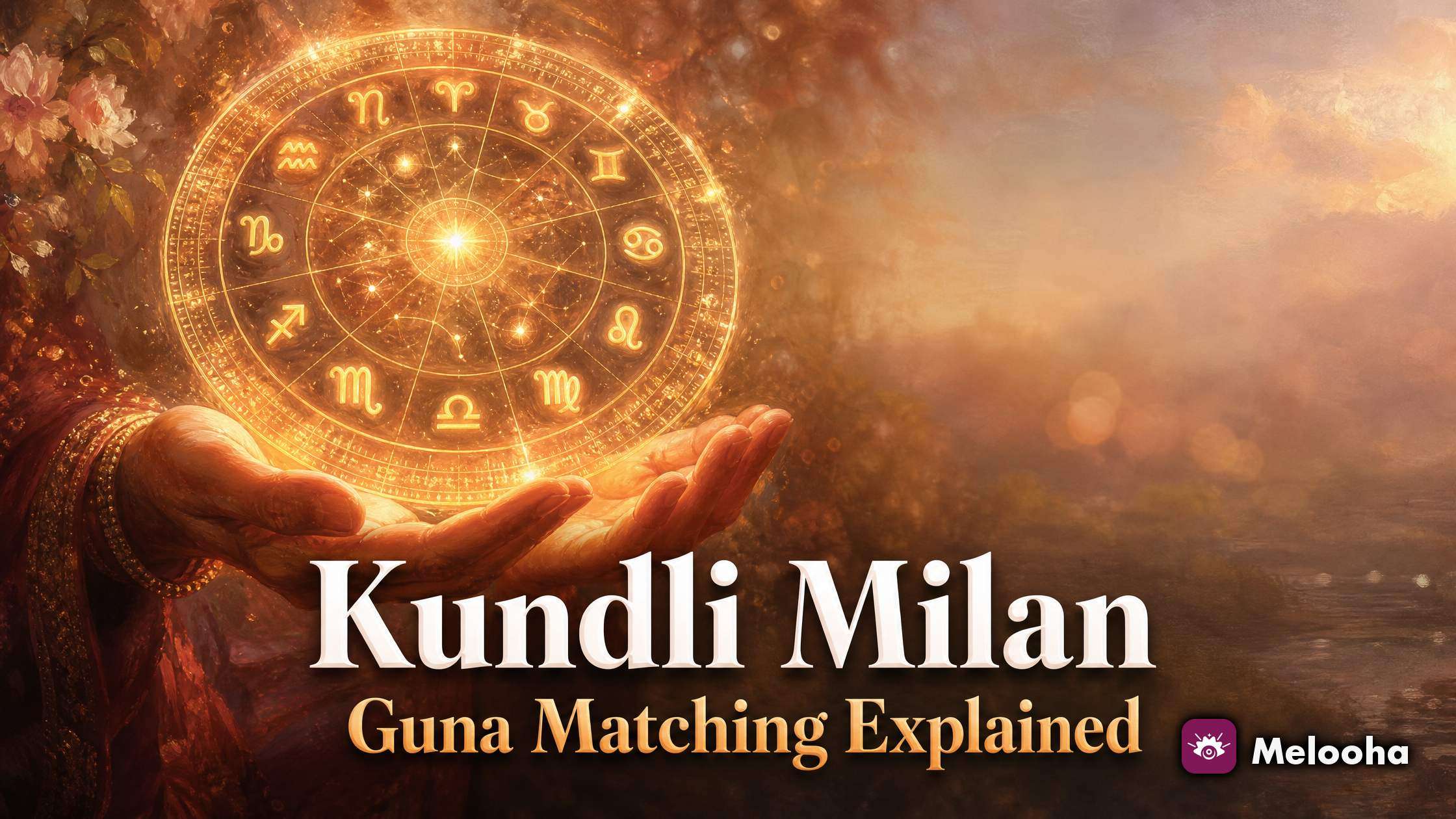
Horoscope matching for marriage, or kundli milan, compares the bride's and groom's Moon nakshatras using the Ashtakoot system, which scores eight factors for a total out of 36. Traditionally 18 or more is considered acceptable, though a full match also looks at Mangal dosha, the 7th house and the dashas running in both charts. A low score does not automatically rule out a marriage: Nadi and Bhakoot doshas have recognised exceptions, and practice differs by family and region.
- Ashtakoot matching scores eight factors from both partners' Moon nakshatra and rashi for a total out of 36.
- Nadi (8 points) and Bhakoot (7 points) carry the most weight, so they decide most low scores.
- Traditional exceptions can cancel Nadi and Bhakoot doshas, so read the breakdown, not just the total.
- Guna milan is one layer; Mangal dosha, the 7th house and running dashas complete the picture.
What is horoscope matching for marriage?
Horoscope matching is the Vedic practice of comparing two birth charts before marriage to judge temperament, attraction, health and long-term harmony. The most widely used method in North and West India is Ashtakoot guna milan, which works entirely from the Moon's nakshatra and rashi at each person's birth. Because the Moon represents the mind and emotions in Jyotish, matching Moons is treated as matching how two people feel and react. In South India, the Dashakoot or Porutham system with ten factors is more common. Both systems rest on principles laid out in classical texts such as Brihat Parashara Hora Shastra and Muhurta Chintamani.
What are the eight kootas and what does each measure?
The eight kootas, with their maximum points, are: Varna (1), spiritual and working temperament; Vashya (2), mutual influence and who draws whom; Tara (3), birth-star compatibility tied to wellbeing and fortune; Yoni (4), physical and instinctive compatibility; Graha Maitri (5), friendship between the Moon-sign lords, which reflects mental wavelength; Gana (6), basic nature, classed as Deva, Manushya or Rakshasa; Bhakoot (7), the relative placement of the two Moon signs, linked to family welfare and finances; and Nadi (8), linked traditionally to health and progeny. Add them up and you get 36. Notice how the weights climb: Bhakoot and Nadi together are worth 15 points, which is why they dominate most results.
What guna score is good for marriage?
The common traditional reading is: below 18 is not recommended without careful review, 18 to 24 is acceptable, 25 to 32 is very good, and above 32 is excellent. These bands are guidance, not a verdict. A score of 28 with a serious Mangal dosha mismatch may need more thought than a score of 17 where the Nadi dosha is traditionally cancelled. Astrologers treat the total as an entry point and then look at which kootas scored zero and why.
What does a real match look like, koota by koota?
Here is one worked example for illustration, not anyone's personal result. The bride has Moon in Rohini nakshatra, Vrishabh rashi; the groom has Moon in Swati nakshatra, Tula rashi. The breakdown: Varna 0 of 1, Vashya 2 of 2, Tara 1.5 of 3, Yoni 2 of 4, Graha Maitri 5 of 5, Gana 6 of 6, Bhakoot 0 of 7, Nadi 0 of 8. Total: 16.5 out of 36, a result that on its face needs remedies. Look closer, though. This couple scores full marks on Graha Maitri and Gana, the two kootas most tied to mental friendship and nature, and on Vashya. The whole shortfall comes from Bhakoot and Nadi, 15 points between them. Vrishabh and Tula are both ruled by Venus, and some traditions cancel Bhakoot dosha when the two Moon-sign lords are the same or friendly. Nadi exceptions also exist, though which ones apply varies by tradition. So a pair that looks like a weak match on the number can read quite differently once the exceptions are checked.
What are Nadi dosha and Bhakoot dosha, and can they be cancelled?
Nadi dosha arises when both partners share the same Nadi (Aadi, Madhya or Antya) and scores 0 of 8. Bhakoot dosha arises when the two Moon signs sit in certain unfavourable relationships, such as 6-8, 2-12 or 5-9 from each other, and scores 0 of 7. Classical commentators list exceptions: for example, when both Moon signs share the same lord or the lords are friends, or when the nakshatras differ though the rashi is the same. Which exceptions a family accepts differs by tradition and region, so it is worth asking an astrologer to state clearly which rule they are applying.
What else should be checked beyond guna milan?
Guna milan looks only at the Moon. A thorough match also checks Mangal dosha in both charts, the 7th house and its lord (the house of marriage), Venus for the groom and Jupiter for the bride in traditional reading, and the Vimshottari dashas each person will run in the early years of marriage. Two people with a middling score but supportive 7th houses and well-timed dashas are often read more favourably than the number suggests. Melooha's compatibility checks look at Ashtakoot guna milan together with these deeper chart factors, for marriage and for love.
How can I check our horoscope match?
You need each person's date of birth, exact birth time and birth place. The birth time matters because the Moon changes nakshatra roughly every day, and a match near a nakshatra boundary can change with a small time error. Enter both sets of details in a kundli milan calculator to get the eight-koota breakdown, then check Mangal dosha separately. If the score is low, look first at which kootas are zero before drawing conclusions.
What remedies are suggested when the score is low?
Traditional remedies depend on which dosha is present and are chosen by the family's astrologer or priest. Commonly mentioned practices include Nadi dosha nivaran puja, Maha Mrityunjaya japa, charity, and worship of the planet linked to the weak koota. Practices differ widely by family and region, and no remedy can be presented as guaranteeing an outcome. Many families also weigh compatibility of values, communication and shared goals alongside the chart, which is sensible whatever the score.
- Brihat Parashara Hora Shastra
- Muhurta Chintamani
- Lahiri ayanamsa
Frequently Asked Questions
Traditionally at least 18 of 36 gunas are considered acceptable. Scores above 24 are considered very good. Always check the breakdown too, since zero in Nadi or Bhakoot matters more than the total alone.
Not necessarily. In one illustrative case of a Rohini bride and Swati groom scoring 16.5 of 36, all the lost points came from Bhakoot and Nadi, both of which have traditional exceptions. An astrologer would check those before advising.
You can do a rough match from the Moon sign if the Moon stayed in one nakshatra all day, but it is unreliable otherwise. Mangal dosha and 7th house analysis need an accurate birth time.
It is a personal and family choice. Many couples in love marriages still check the match to understand likely friction points and timing rather than to decide yes or no. On Melooha you can ask a specific relationship question and get a structured answer on what is happening, why, and what to do next.
No. Classical tradition lists exceptions, such as different nakshatras within the same rashi or the same rashi lord, though which ones are accepted varies by family and region.
Every article is checked against the classical texts by our astrologers before it goes up.

Related reading
Latest articles