AI Kundli Matching: How It Scores Nadi Dosha and What to Do Next
What an AI kundli match actually calculates, why a zero in Nadi worries families, and how to read the result without panic.
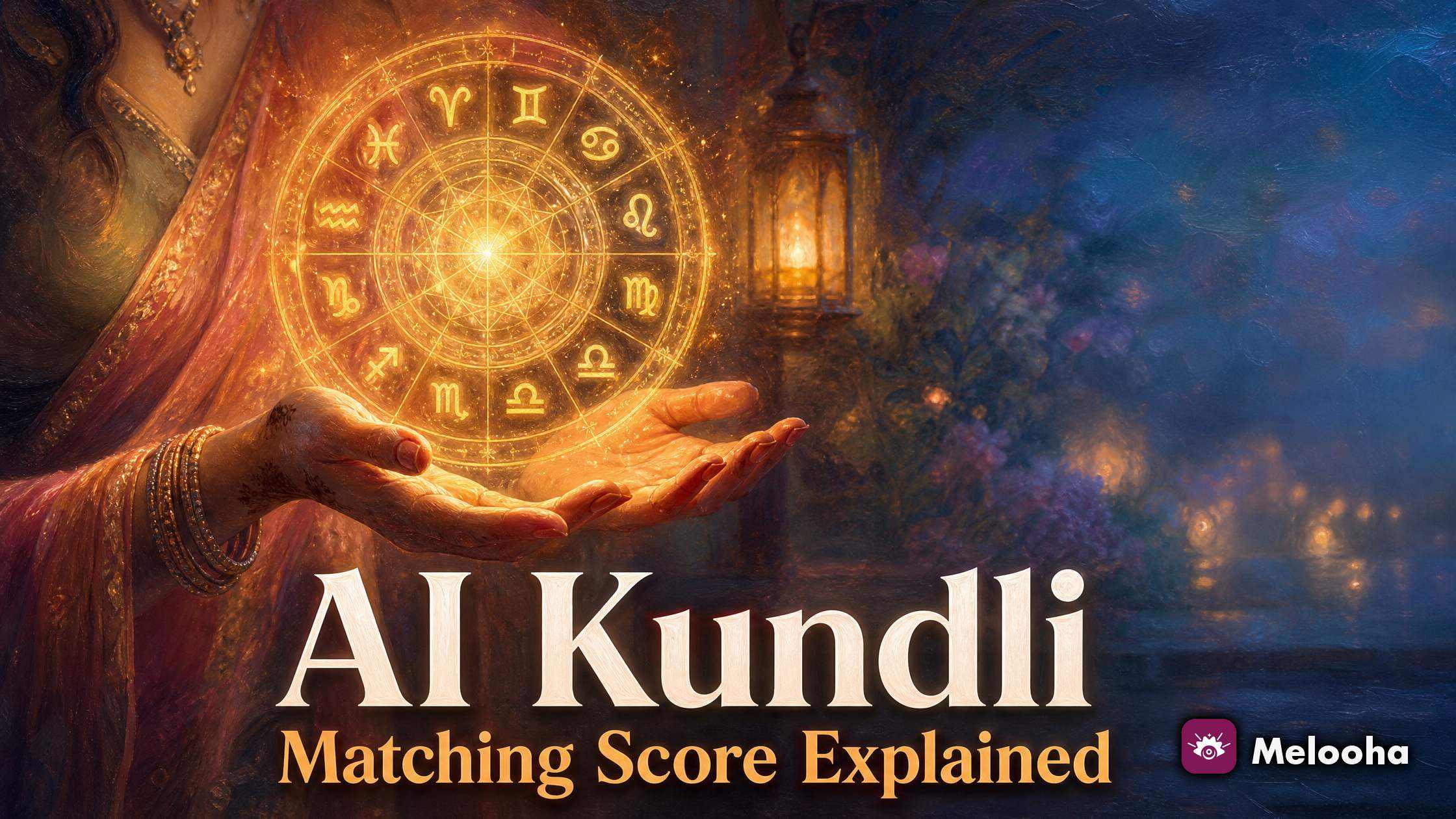
AI kundli matching uses both partners' birth date, time and place to compute their Moon nakshatras and score the eight Ashtakoot factors out of 36 gunas, with Nadi carrying the most weight at 8 points. Nadi dosha arises when both partners share the same Nadi, which scores 0 of 8. Traditionally it is treated as serious, but classical texts list exceptions that vary by tradition, so a low score calls for a fuller chart review rather than an automatic no.
- AI kundli matching is the traditional Ashtakoot guna milan, calculated by software from exact birth details instead of by hand.
- Nadi is the heaviest of the eight kootas at 8 of 36 points, and a same-Nadi pair scores 0.
- Many traditions recognise exceptions that cancel or soften Nadi dosha, so read the whole chart before deciding.
- A guna total is one input among several, alongside Mangal dosha, the 7th house and the running dashas.
What does AI kundli matching actually do?
AI kundli matching is the familiar Ashtakoot guna milan done by software. You enter each partner's date, time and place of birth; the engine calculates the sidereal Moon position (usually with the Lahiri ayanamsa), identifies each person's nakshatra and rashi, and then scores eight factors: Varna, Vashya, Tara, Yoni, Graha Maitri, Gana, Bhakoot and Nadi, for a total out of 36. The advantage over a hand-drawn match is consistency and precision. A person born near a nakshatra boundary can get a different Moon star if the birth time is rounded, and that can swing Nadi or Bhakoot entirely. Software removes arithmetic errors, but it cannot fix a wrong birth time, so check that first.
What is Nadi dosha?
Every nakshatra belongs to one of three Nadis: Aadi (Vata), Madhya (Pitta) and Antya (Kapha). In Ashtakoot matching, partners from different Nadis receive the full 8 points. Partners from the same Nadi receive 0, and that zero is called Nadi dosha. Because Nadi is the single largest block in the 36-point system, one same-Nadi result removes more than a fifth of the possible score in one stroke. That is why it draws so much attention in family discussions.
What does a real match with Nadi dosha look like?
Here is one worked example, for illustration only. It is not your result. Bride: Rohini nakshatra, Vrishabh rashi. Groom: Swati nakshatra, Tula rashi. Both Rohini and Swati fall in the same Nadi, so Nadi scores 0 of 8. The full breakdown: Varna 0 of 1, Vashya 2 of 2, Tara 1.5 of 3, Yoni 2 of 4, Graha Maitri 5 of 5, Gana 6 of 6, Bhakoot 0 of 7, Nadi 0 of 8. Total: 16.5 out of 36, a result conventionally read as needing remedies. Notice what the total hides. This pair scores full marks on Graha Maitri and Gana, the factors often linked to mental rapport and temperament. The low total comes almost entirely from Bhakoot and Nadi. A good reading looks at where the points were lost, not just the headline number.
What are the traditional effects of Nadi dosha?
Traditional texts associate Nadi dosha with concerns about health, physical constitution and progeny, since Nadi is linked to the Ayurvedic doshas of Vata, Pitta and Kapha. Some astrologers also connect it with friction arising from too-similar temperaments. These are traditional associations, not predictions of fact. Many couples with Nadi dosha have long, healthy marriages, and the dosha is weighed differently across schools and regions.
Can Nadi dosha be cancelled?
Yes, according to many traditions. Commonly cited exceptions involve cases such as both partners sharing the same rashi but different nakshatras, or the same nakshatra but different rashis or padas, and cases where the rashi lords are friendly. Which exceptions apply, and how strongly, varies by tradition, so two astrologers can reach different conclusions about the same pair. This is also where software settings matter: check whether your matching tool reports cancellations and which rules it follows.
What remedies are traditionally suggested for Nadi dosha?
Remedies commonly suggested include Mahamrityunjaya japa, charity, and prayers or pujas performed before marriage, but the specific practice differs by family, region and astrologer. Many families simply ask a trusted astrologer to review the full charts before settling on anything. The most practical step is a wider check: Mangal dosha in both charts, the strength of the 7th house and its lord, Venus, and the dasha periods each person will run in the early years of marriage. A strong overall picture often matters more than one koota. Melooha's compatibility checks look at Ashtakoot guna milan together with the deeper chart factors behind a relationship, for marriage and for love.
How should you check your own match?
Gather exact birth details for both partners, ideally from a birth certificate or hospital record. Run the Ashtakoot match, note the koota-wise breakdown, and see whether Nadi or Bhakoot is flagged and whether any exception applies. Then look at Mangal dosha separately, since it is not part of the 36 gunas. Melooha's free Kundli Milan calculator computes from your own birth details, so you can see your real breakdown rather than a generic example.
- Lahiri ayanamsa
- Brihat Parashara Hora Shastra
- Muhurta Chintamani
Frequently Asked Questions
The calculation is only as accurate as the birth details entered. With a correct birth time and place, software gives consistent Ashtakoot scores; the interpretation still follows tradition and is guidance, not certainty.
Not automatically. Many traditions recognise exceptions, and astrologers weigh the whole chart. Treat it as a reason for a closer review.
Conventionally, 18 of 36 is often cited as the minimum, but a higher total with a serious dosha can be weaker than a moderate total with strong supporting factors.
The calculation is the same regardless of how the couple met. How much weight a family gives it is a personal choice.
Nadi dosha comes from both partners sharing a Nadi and costs 8 points. Bhakoot dosha comes from certain rashi relationships between the two Moon signs, such as 6-8 or 2-12, and costs 7 points.
Every article is checked against the classical texts by our astrologers before it goes up.

Related reading
Latest articles